

The Signal
Scoring tools flag interest faster than most teams act on it.
The Growth Stage
Your CRM can spot interest. Your team decides what happens next.

THE AUTHOR
By Luna Clervaux-Morris · Founder, FourStage & Co.
WHAT WE’RE WATCHING
Scoring tools flag interest faster than most teams act on it.
Interest has a shelf life, and a competitor’s reply can end it.
A strong lead system names one person, one action, and one deadline.
At 9:14 on a Tuesday morning, a facilities director at a regional hospital system filled out a form on Priya Nair’s website. Priya leads business development at a 30-person engineering firm. The director had already downloaded the firm’s guide to phased renovations and read two case studies. Her message was direct: “We’re planning a wing renovation for next spring. How do you scope projects like this?”
The CRM scored the lead at 92. The record turned red on the dashboard. A notification went to the shared new-business inbox, where four people saw it.
Each of them had a reasonable assumption. The principal figured business development would take it. Business development figured the principal would want a healthcare lead personally. The senior project manager was on a job site all week.
Priya spotted the record on Friday during her weekly review and called first thing Monday. The director was gracious. “We had a good call with another firm on Wednesday,” she said. “They sent a proposal outline yesterday.”
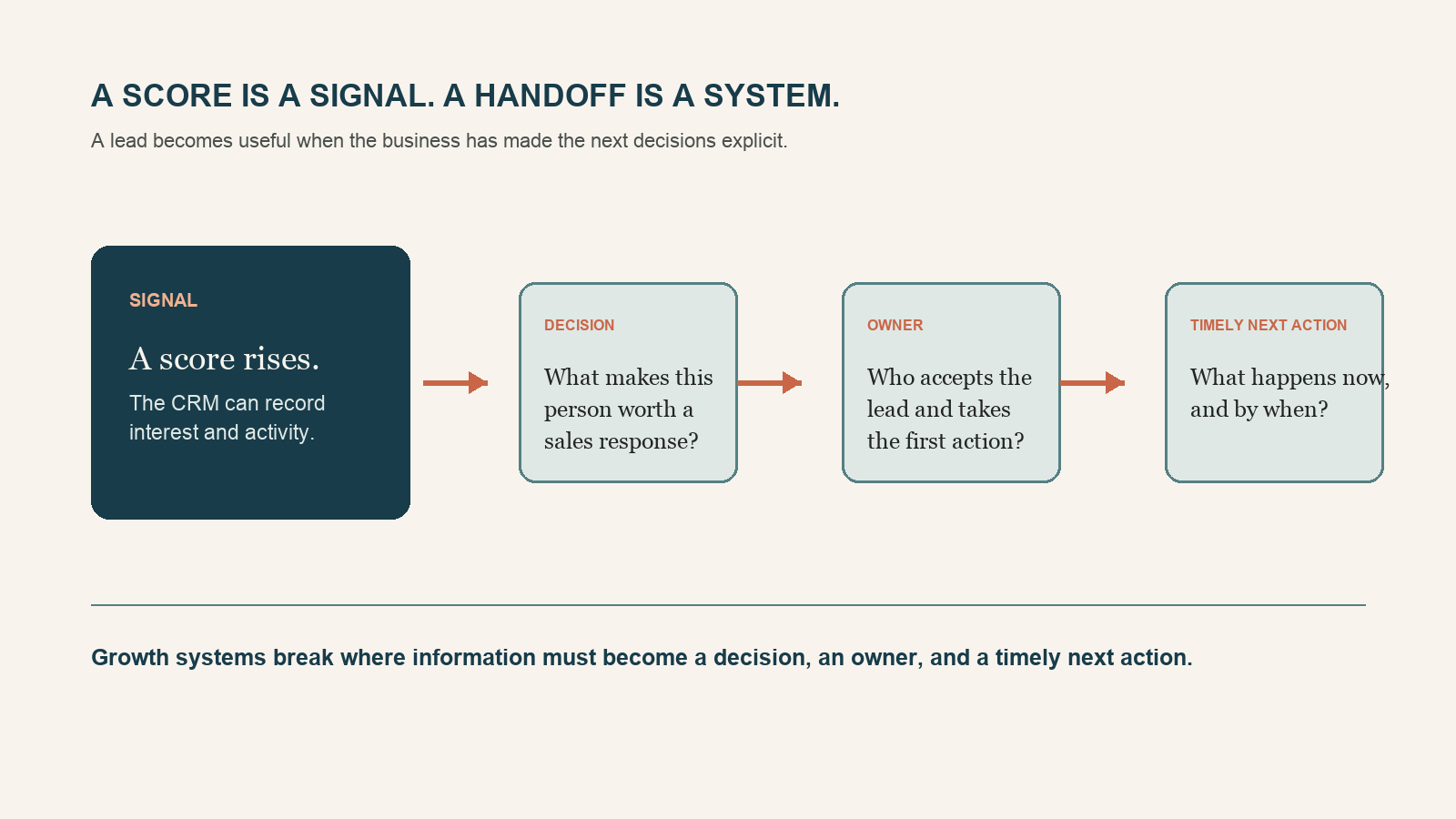
The scoring worked exactly as designed. What the firm lacked was a route: a rule saying whose lead it was, and by when.

A lead score measures activity. A guide download and a scoping question can produce similar scores, yet they ask for very different things. The download asks for a resource. The scoping question asks for a person.
Start by listing the inquiries your business receives most often. Give each one a response, an owner, and a deadline. Here is how Priya’s firm mapped theirs:
Each line reduces to one routing rule anyone on the team can apply: When [inquiry type] arrives, [owner] responds with [action] by [time].

A 2013 study in the Journal of Marketing titled “The Sales Lead Black Hole” followed 461 sales reps across four firms. How consistently reps pursued marketing leads depended partly on whether leads were prequalified and whether managers tracked the follow-up. Clear expectations shaped the follow-up.
A readiness rule makes those expectations explicit. It names the few facts that signal a lead deserves a personal reply:
Priya’s firm wrote theirs in one sentence: A request to scope a healthcare or education facility project is ready for a business development reply.
Budget and timing can wait for the first conversation. The hospital director’s message met the rule the moment she sent it.

A notification to four people gives each of them a quarter of the responsibility. A handoff works when one person knows the lead is theirs, knows the deadline, and has a named backup for days they are out.
Before automating anything, build the handoff record. Six fields cover it:
The first reply should answer the buyer’s actual question. Here is what Priya’s lead could have sent on Tuesday afternoon:
Hi Dana, thanks for reaching out about the wing renovation. Phased work in an active hospital usually turns on two early questions: which departments must stay open, and during which months. Could you share your target start window? I’d welcome a 20-minute call to walk through how we’d scope it.
It takes five minutes to write. It shows expertise in the first sentence and asks for one easy next step.

Sending the reply starts the handoff. Recording the result completes it. Every lead should land in one of four states:
Once a month, pull your last ten handoffs and check who acted, how fast, and what happened. The patterns point to the fix. Slow replies point to routing. Repeated poor fits point to the readiness rule or the content attracting them. Calls that stall on the same question point to information your website should share earlier.
Priya’s firm put its routing rules live the following week. A month later, a school district inquiry arrived at 4:40 on a Thursday afternoon. The business development lead replied by 10 the next morning, and the call was booked for the following Tuesday. The lead scored about the same as the hospital’s. This time, it had a route.
YOUR MOVE
Pick the inquiry type that matters most to your revenue. Fill in its handoff record: owner, backup, respond-by time, first action, and the four outcomes. Then run your most recent real inquiry through it and note where it would have waited.
RESEARCH BEHIND THIS ISSUE
Sabnis, Chatterjee, Grewal, and Lilien · Journal of Marketing · 2013
“The Sales Lead Black Hole: On Sales Reps’ Follow-Up of Marketing Leads.” A study of 461 reps across four firms on prequalification, managerial tracking, lead volume, and follow-up. It examines organizational process and sets no response-time benchmark.
Wu, Andreev, and Benyoucef · Information Technology and Management · 2023
A systematic review of 44 studies on lead-scoring models and their effect on sales performance.
Priya Nair and the people in this story are a composite, drawn from patterns common across professional-services firms. Names and details are illustrative.
FOURSTAGE INSIGHTS
YOUR TURN
Share your answer or a question about brand, growth, or the structure of your business. A person at FourStage reads every submission, and the best questions may shape a future issue.